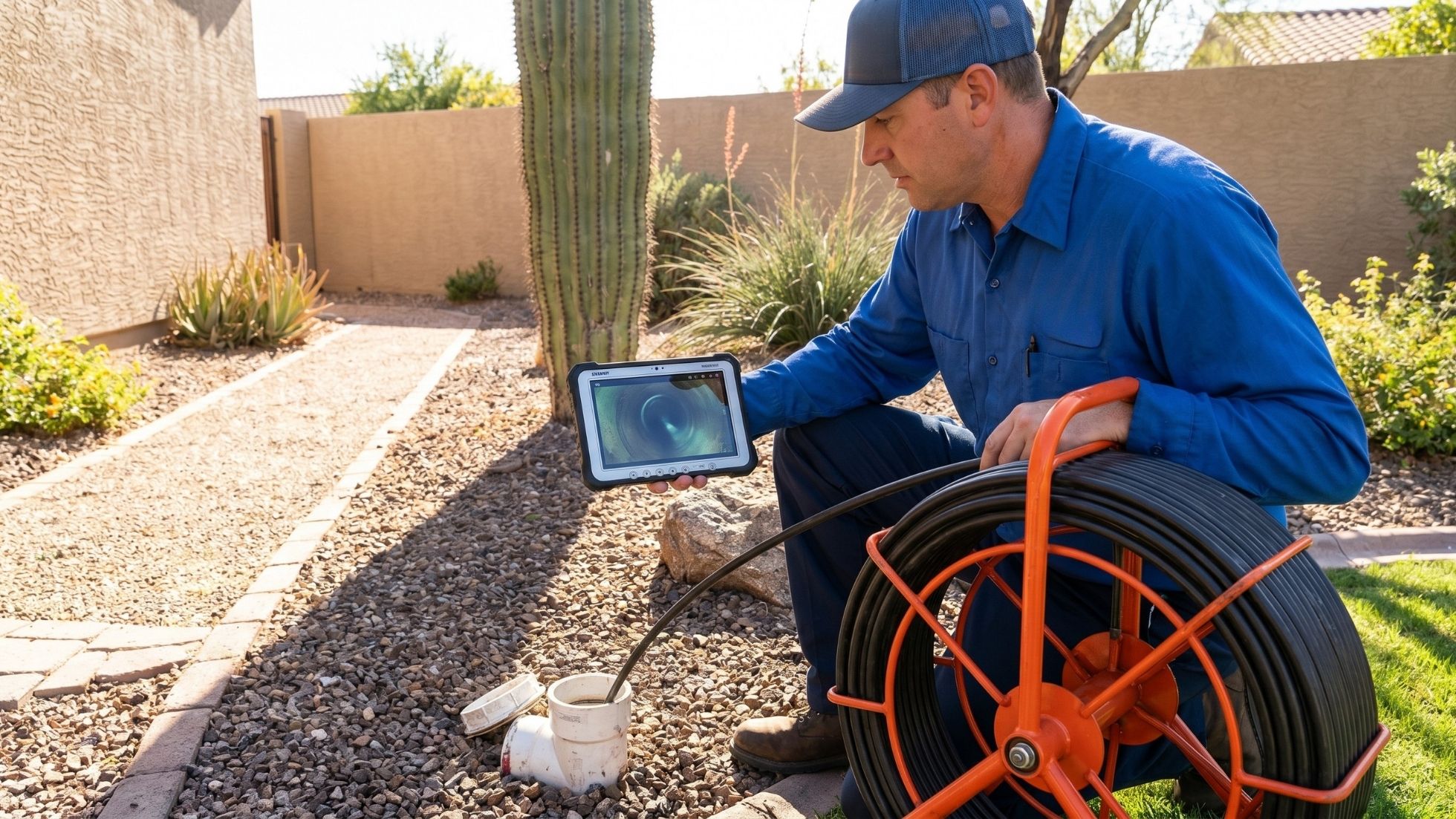
A plumbing camera inspection is the definitive method for diagnosing hidden issues within your sewer and drain lines without destructive digging. In Phoenix, where shifting soil, invasive tree roots, and aging infrastructure create unique challenges, a high-resolution video inspection reveals blockages, cracks, and structural failures that would otherwise remain invisible. This technology transforms guesswork into precision, saving homeowners thousands in unnecessary excavation costs.
Key Takeaways
- A sewer camera inspection provides real-time visual evidence of pipe condition, eliminating diagnostic guesswork.
- Phoenix homes face specific threats including caliche soil shifts, mesquite root intrusion, and cast iron pipe deterioration.
- Inspections detect cracks, offset joints, bellied pipes, root masses, and corrosion before they cause catastrophic failure.
- Video documentation is essential for insurance claims, real estate transactions, and verifying repair work.
- Professional camera inspections by Rapid Fire Plumbing include a detailed report with recommendations for sewer line repair in Phoenix.
- Annual inspections are recommended for homes over 30 years old or properties with mature landscaping.
The Technology Behind Sewer Camera Inspections
Modern plumbing diagnostics rely on specialized waterproof cameras attached to flexible fiber optic cables. These devices transmit high-definition video to a monitor above ground, allowing the technician to navigate through pipes as small as 1.5 inches in diameter. The camera head features powerful LED lighting to illuminate the darkest pipe interiors, and a self-leveling lens ensures the image remains upright regardless of the camera’s orientation. According to the National Association of Sewer Service Companies (NASSCO), video inspection technology has reduced unnecessary excavation by over 60% in municipal and residential applications.
Advanced units incorporate sonde transmitters that emit a radio frequency detectable from the surface. This allows the plumber to pinpoint the exact location and depth of a defect, marking it on the ground for targeted repair. Some systems also integrate laser profiling to measure pipe diameter changes and calculate the percentage of obstruction. As Mark Stevens, Senior Field Technician at Rapid Fire Plumbing, explains: “The camera doesn’t just show us a problem — it tells us exactly where to dig, how deep, and what we’ll find when we get there. That precision is invaluable in Phoenix’s hard-packed soil.”
Common Issues Revealed by Camera Inspections in Phoenix
Phoenix’s unique geological and botanical environment creates a distinct set of plumbing challenges. The Sonoran Desert’s expansive clay soils, known locally as caliche, undergo significant volume changes with moisture fluctuations. This constant expansion and contraction places immense stress on buried pipes, leading to specific failure patterns that a camera inspection readily identifies.
Root Intrusion from Desert-Adapted Vegetation
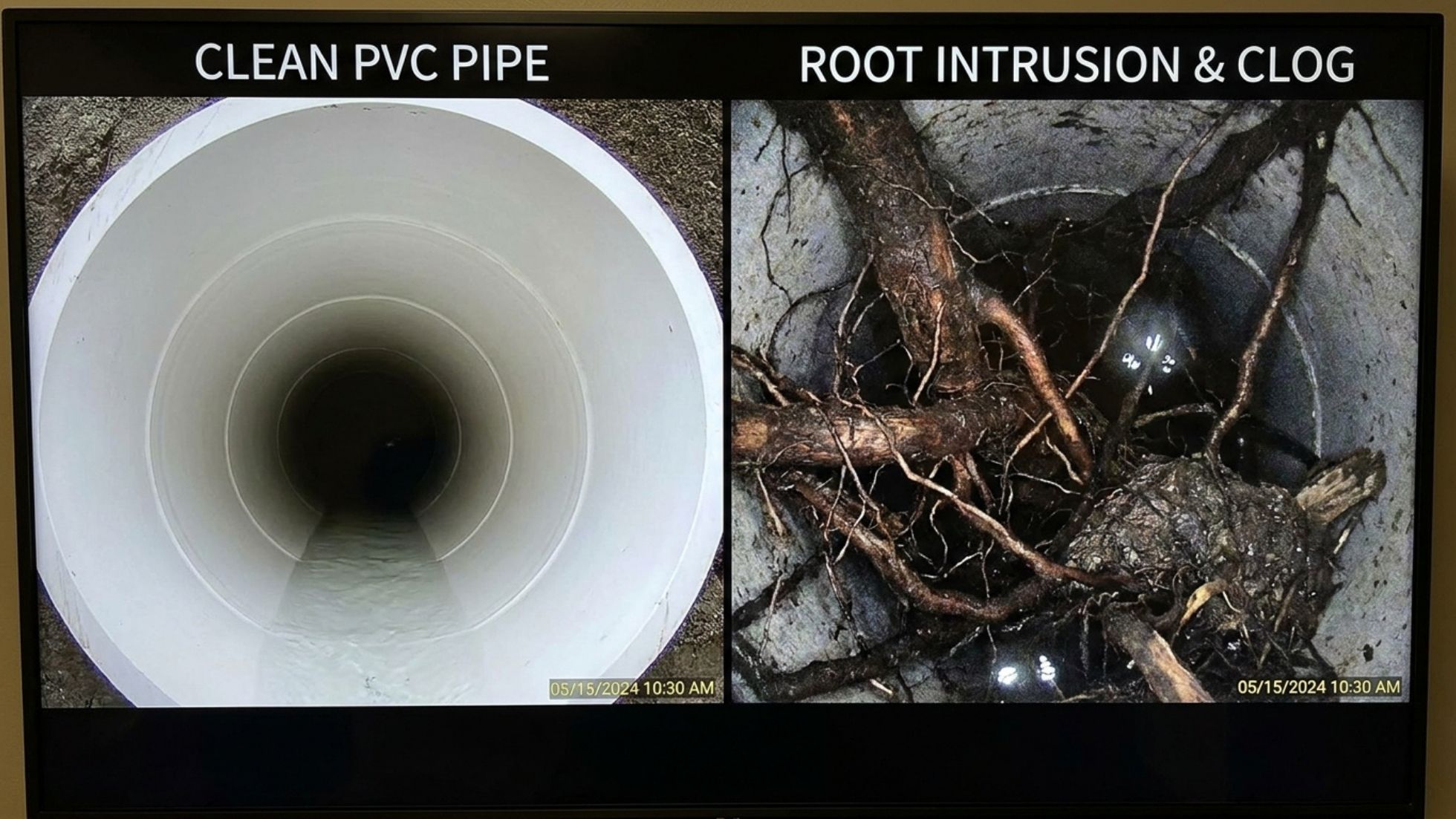
Mesquite, palo verde, and desert willow trees aggressively seek water sources, and a tiny pipe joint leak is an irresistible target. Camera footage often reveals dense root masses that have penetrated pipe joints and grown into thick mats, trapping debris and causing severe blockages. Research from the University of Arizona Cooperative Extension indicates that mesquite roots can extend up to 50 feet laterally, far beyond the tree’s canopy. A camera inspection maps the extent of root intrusion and determines whether hydro jetting or mechanical cutting is the appropriate remediation.
Cast Iron Pipe Deterioration
Many Phoenix homes built before 1980 feature cast iron sewer lines. Over decades, the interior surface corrodes and develops tuberculation — rust nodules that constrict flow and snag debris. The camera reveals the characteristic orange-brown scaling and pitting. In advanced stages, the pipe bottom may be completely eroded, a condition known as “channel rot.” The U.S. Environmental Protection Agency notes that cast iron pipes have an expected service life of 50-75 years, meaning many Phoenix homes are now in the failure window.
Offset Joints and Bellied Pipes
Soil movement in Phoenix’s expansive terrain frequently causes pipe sections to separate at the joints, creating offsets where the bore is no longer aligned. The camera shows a distinct misalignment, often with soil intrusion. Similarly, a “belly” or sag forms when the supporting soil compacts unevenly, creating a low spot where water and waste stagnate. The camera’s self-leveling feature makes these sags immediately apparent as standing water appears in the pipe.
| Defect Type | Camera Visual Signature | Common Phoenix Cause | Recommended Action |
|---|---|---|---|
| Root Intrusion | Fibrous masses at joints, water flow obstruction | Mesquite, palo verde seeking moisture | Hydro jetting, root killer, or pipe lining |
| Cast Iron Corrosion | Orange-brown tuberculation, pitting, channel rot | Age, soil chemistry, moisture | Pipe lining or full replacement |
| Offset Joint | Misaligned pipe sections, visible gap | Caliche soil expansion/contraction | Spot repair or trenchless realignment |
| Belly/Sag | Standing water in pipe, debris accumulation | Soil compaction, poor bedding | Pipe bursting or excavation |
| Grease/Scale Buildup | Layered deposits reducing pipe diameter | Kitchen waste, hard water minerals | Hydro jetting, descaling |
When to Schedule a Plumbing Camera Inspection
Proactive homeowners use camera inspections as a diagnostic tool before symptoms escalate into emergencies. Certain scenarios demand immediate inspection. Recurring drain clogs that resist conventional snaking suggest a structural defect rather than a simple blockage. Gurgling sounds from toilets or drains indicate trapped air caused by a partial obstruction or venting issue. Foul odors emanating from drains or yard areas often signal a cracked pipe leaking sewage into the soil.
Real estate transactions represent another critical application. A standard home inspection does not include a sewer scope, yet a failed sewer line can cost $10,000 to $25,000 to replace. The American Society of Home Inspectors recommends sewer scopes for any home over 20 years old. As Lisa Tran, a Phoenix real estate agent with over 15 years of experience, states: “I won’t let my buyers close without a sewer camera inspection. I’ve seen too many deals where a hidden pipe collapse turned a dream home into a financial nightmare within the first month.”
For homeowners experiencing recurring drain clogs in Phoenix, a camera inspection moves beyond treating symptoms to identifying root causes. The same applies when multiple fixtures drain slowly simultaneously — this pattern often points to a main line issue rather than isolated branch problems.
 The Inspection Process: Step-by-Step
A professional plumbing camera inspection follows a systematic protocol to ensure comprehensive evaluation. Understanding the process helps homeowners appreciate the thoroughness of the service.
- Access Point Identification: The technician locates a suitable entry point, typically a cleanout fitting, roof vent, or toilet removal. In Phoenix homes without cleanouts, pulling a toilet provides the most direct access to the main sewer line.
- Initial Visual Assessment: Before inserting the camera, the plumber evaluates accessible drain openings, notes any visible damage, and discusses symptom history with the homeowner.
- Camera Insertion and Navigation: The camera is carefully fed through the pipe while the technician monitors the live feed. The self-leveling lens maintains orientation as the camera traverses bends and junctions.
- Defect Documentation: When anomalies appear, the technician captures still images and records video clips. The sonde transmitter is activated to mark the defect’s precise location and depth from the surface.
- Complete Line Mapping: The camera travels the full length of the accessible pipe, typically to the municipal connection or septic tank inlet. Distance is tracked via a counter on the cable reel.
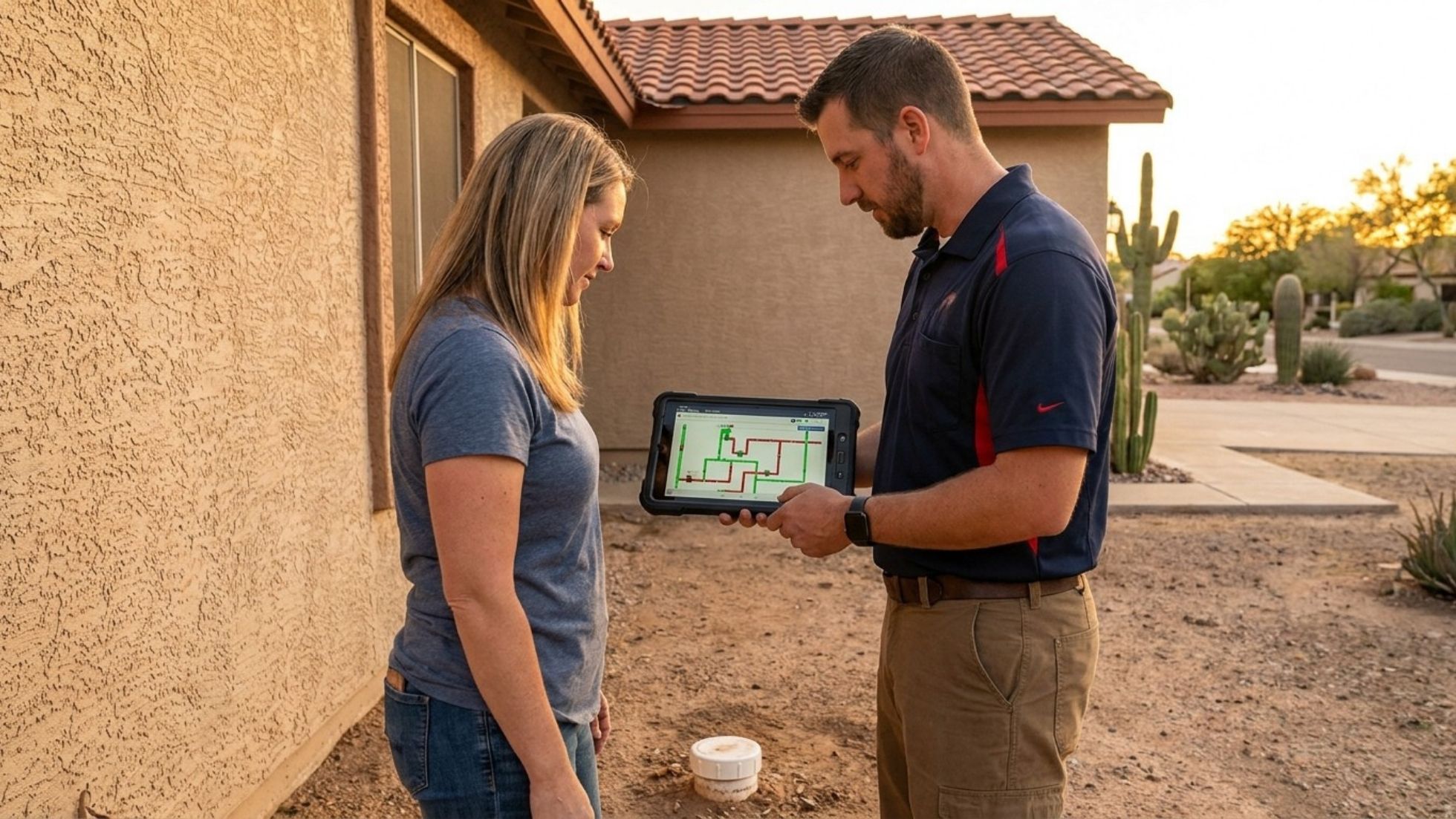
- Report Generation: After retrieval, the plumber compiles findings into a detailed report with annotated images, a pipe diagram, and prioritized recommendations.
- Review and Planning: The technician reviews the footage with the homeowner, explaining each finding and discussing repair options, including trenchless alternatives where applicable.
Interpreting Camera Inspection Results
Understanding the terminology and visual cues in an inspection report empowers homeowners to make informed decisions. The Pipe Assessment Certification Program (PACP) developed by NASSCO provides standardized coding for pipe defects, which professional plumbers use to ensure consistent reporting.
A camera inspection report typically grades defects by severity. Grade 1 indicates minor issues requiring monitoring. Grade 2 suggests moderate deterioration that will eventually need repair. Grade 3 denotes significant structural compromise requiring near-term action. Grade 4 represents failure or collapse demanding immediate attention. According to NASSCO data, approximately 30% of residential sewer lines inspected nationwide exhibit Grade 3 or higher defects.
Common report findings include circumferential cracks that extend around the pipe’s full diameter, indicating significant stress. Longitudinal cracks run along the pipe’s length and often result from manufacturing defects or improper bedding. Offset joints appear as a visible step between pipe sections. The report also documents the pipe material, diameter, and any transitions between materials that may create flow restrictions.
Cost Considerations and Value in Phoenix
In the Phoenix metro area, a standalone plumbing camera inspection typically ranges from $250 to $500, depending on accessibility and the length of pipe inspected. Many plumbing companies, including Rapid Fire Plumbing, waive or discount the inspection fee when it leads to a major repair. This investment is minimal compared to the cost of unnecessary excavation or emergency repairs.
The real value lies in diagnostic precision. Without a camera, a plumber facing a recurring blockage might recommend excavating a 20-foot trench to replace a suspected bad section. With camera verification, the repair targets only the specific damaged area, or better yet, confirms that trenchless pipe lining can rehabilitate the entire line without digging. The savings routinely exceed $5,000. For homeowners dealing with emergency plumbing in Phoenix, a camera inspection provides immediate clarity during a stressful situation.
Trenchless Repair Options Identified by Camera
One of the most valuable outcomes of a camera inspection is determining candidacy for trenchless repair methods. Cured-in-place pipe (CIPP) lining involves inserting an epoxy-saturated liner that cures to form a new pipe within the old one. The camera verifies that the host pipe has sufficient structural integrity to support the liner and that no collapsed sections would prevent insertion.
Pipe bursting, another trenchless technique, pulls a new pipe through the old one while fracturing the original outward. Camera inspection confirms the pipe path is clear of obstructions like concrete encasements or adjacent utilities that would interfere with bursting. The inspection also identifies lateral connections that must be reinstated after lining.
As David Chen, Trenchless Technology Specialist, notes: “The camera doesn’t just diagnose — it determines the treatment plan. Without seeing the pipe interior, we’re just guessing whether lining will work. With high-definition footage, we can measure diameters, assess ovality, and identify every lateral connection with confidence.”
 Preventative Maintenance and Long-Term Planning
Forward-thinking Phoenix homeowners incorporate camera inspections into their property maintenance schedules. For homes over 30 years old with original cast iron or clay pipes, an annual inspection establishes a baseline and tracks deterioration rates. Properties with large, mature trees benefit from biennial inspections to monitor root encroachment before blockages form.
The inspection footage becomes a valuable historical record. Comparing current video to previous inspections reveals the rate of corrosion progression or root regrowth. This data-driven approach allows homeowners to budget for eventual replacement on their timeline rather than reacting to emergencies. The U.S. Environmental Protection Agency emphasizes that preventative infrastructure maintenance significantly reduces both costs and environmental impact compared to reactive repairs.
For homeowners considering repiping services in Phoenix, camera inspection data informs the scope of work and material selection. Understanding the condition of the entire system prevents the mistake of replacing only visible sections while leaving compromised pipes hidden in walls or slabs.
Frequently Asked Questions
How long does a plumbing camera inspection take?
A typical residential sewer camera inspection takes 45 to 90 minutes, depending on the length of the line and the number of defects requiring documentation. Complex systems with multiple branches or difficult access points may require up to two hours for a thorough evaluation.
Can a camera inspection find leaks in my pipes?
Yes, a camera inspection identifies active leaks by showing water infiltration through cracks, separated joints, or holes. The camera may also reveal mineral deposits or soil staining that indicates intermittent leakage. However, very small pinhole leaks in pressurized water supply lines require separate acoustic or thermal detection methods.
Is a camera inspection necessary before buying a home in Phoenix?
Absolutely. Phoenix’s soil conditions and the prevalence of aging cast iron pipes make sewer scopes essential during real estate transactions. The American Society of Home Inspectors strongly recommends sewer line inspections for any home over 20 years old. The cost is negligible compared to potential repair expenses.
What’s the difference between a camera inspection and a sewer scope?
These terms are often used interchangeably. A sewer scope specifically refers to inspecting the main sewer line from the house to the municipal connection. A plumbing camera inspection is broader and may include branch drain lines, vent stacks, and interior plumbing. Both use similar camera technology.
Will the camera get stuck in my pipes?
Professional-grade inspection cameras are designed to navigate bends, offsets, and partial blockages. The flexible push rod allows the technician to maneuver past most obstacles. In rare cases where a complete collapse or solid obstruction prevents passage, the camera’s location at that point still provides valuable diagnostic information.
How should I prepare for a camera inspection?
Ensure clear access to cleanouts, which are typically located in the yard, garage, or near the foundation. Remove any stored items blocking these access points. The plumber may need to use a water source, so ensure an exterior hose bib is functional. No special preparation is needed inside the home unless toilet removal is required for access.
Can a camera inspection identify problems that cause gurgling drains?
Yes, gurgling drains in Phoenix often indicate venting issues or partial blockages that a camera readily identifies. The inspection can reveal obstructions in vent stacks, waterlogged low spots in drain lines, or developing clogs that trap air and create the characteristic gurgling sound.
Does homeowners insurance cover camera inspections?
Standard homeowners insurance policies typically do not cover preventative camera inspections. However, if an inspection is performed as part of diagnosing a covered claim — such as a sudden pipe rupture — the diagnostic cost may be included in the claim. Check with your insurance provider for specific policy details.
Conclusion
A plumbing camera inspection transforms the invisible interior of your sewer and drain system into a clear, actionable diagnostic picture. For Phoenix homeowners, this technology is particularly valuable given the region’s challenging soil conditions, aggressive tree roots, and aging pipe infrastructure. The inspection reveals root intrusion, corrosion, offset joints, bellied pipes, and other defects with precision that eliminates guesswork and prevents unnecessary excavation.
Whether you’re experiencing recurring drain issues, purchasing a home, or planning preventative maintenance, a professional camera inspection provides the data needed to make informed decisions. Rapid Fire Plumbing combines advanced inspection technology with decades of local experience to deliver comprehensive evaluations and targeted solutions. Contact us today to schedule your plumbing camera inspection and gain clarity on your home’s sewer line condition.
References
- National Association of Sewer Service Companies (NASSCO) — Pipeline Assessment Certification Program standards. https://www.nassco.org
- U.S. Environmental Protection Agency — Drinking Water Infrastructure Needs Survey and Assessment. https://www.epa.gov
- American Society of Home Inspectors — Sewer Scope Inspection Standards. https://www.homeinspector.org
- University of Arizona Cooperative Extension — Desert Tree Root Systems and Water Seeking Behavior. https://extension.arizona.edu
- NASSCO — Industry Statistics on Sewer Line Defect Prevalence in Residential Applications. https://www.nassco.org
